Employee onboarding is one of the most important stages in Human Resource Management because hiring talented employees alone is not enough for long-term organizational success. Companies must also help employees understand workplace culture, responsibilities, systems, communication methods, and team expectations.
A structured employee onboarding process helps organizations improve employee engagement, productivity, workplace satisfaction, and retention. Modern companies now focus heavily on onboarding experiences because employee first impressions often influence long-term performance and workplace relationships.
For beginners entering the HR field, understanding the HR onboarding process is extremely important because onboarding is directly connected to employee management, workplace culture, training, and HR operations.
At HRJobTraining.com, we regularly help HR learners understand practical HR workflows including recruitment, onboarding, payroll systems, employee management, and workplace HR operations.
Quick Summary:
Employee onboarding is the structured process organizations use to integrate new employees into the workplace. It includes preboarding, orientation, training, workplace adaptation, performance support, and employee engagement activities designed to help employees succeed in their roles.
In this beginner-friendly guide, you will learn:
- What employee onboarding means
- Employee onboarding process step by step
- Why onboarding matters in HR
- Modern onboarding strategies
- Common onboarding challenges
- HR onboarding software systems
- Employee onboarding best practices
- How onboarding improves retention
If you are new to HR, you can also explore our detailed Human Resource Management guide to understand how onboarding supports overall HR functions and employee management systems.
Table of Contents
- What Is Employee Onboarding?
- Why Employee Onboarding Is Important
- Employee Onboarding Process Step by Step
- Modern Employee Onboarding Process in HR
- Employee Onboarding Process Best Practices
- Common Employee Onboarding Challenges
- HR Technology in Employee Onboarding
- How to Improve the Employee Onboarding Process
- FAQs About Employee Onboarding
What Is Employee Onboarding?
Employee onboarding is the structured process organizations use to introduce new employees to workplace systems, company culture, job responsibilities, communication structures, and organizational expectations.
The employee onboarding process usually begins immediately after the candidate accepts the job offer and may continue for several weeks or months depending on the organization and role.
Modern onboarding strategies are no longer limited to paperwork or orientation sessions. Today, onboarding focuses heavily on employee experience, employee engagement, mentorship, productivity, communication, and workplace adaptation.
According to onboarding practices discussed by HiBob and AIHR, organizations with strong onboarding systems often experience higher employee retention and improved workforce productivity.
Students interested in practical HR learning can also visit the HRJobTraining blog section to explore HR workflow guides, recruitment systems, payroll operations, and workplace HR processes.
Why Employee Onboarding Is Important
Employee onboarding directly affects employee experience, confidence, engagement, and workplace productivity.
When organizations fail to provide structured onboarding, employees often feel confused, disconnected, or unsupported during the early stages of employment.
A strong onboarding process helps employees understand workplace expectations faster while improving communication and workplace integration.
Benefits of Effective Employee Onboarding:
- Improves employee engagement
- Reduces employee turnover
- Improves workplace productivity
- Builds workplace confidence
- Improves communication
- Strengthens company culture
- Supports long-term employee retention
Common Problems Caused by Poor Onboarding
| Problem | Impact on Organization |
|---|---|
| Poor Communication | Confused and disconnected employees |
| Insufficient Training | Low productivity and workplace mistakes |
| Weak Team Integration | Poor employee engagement |
| Manual HR Processes | Administrative delays and inefficiency |
| Poor Employee Experience | Higher turnover rates |
Modern HR departments increasingly focus on employee onboarding because onboarding experiences strongly influence employee satisfaction and retention.
Students exploring HR career opportunities can also read: HR Career Opportunities in Kerala to understand how HR operations continue evolving across different industries.
Employee Onboarding Process Step by Step
The employee onboarding process usually follows several structured stages. Although onboarding workflows may differ slightly between companies, most organizations follow a similar employee integration structure.
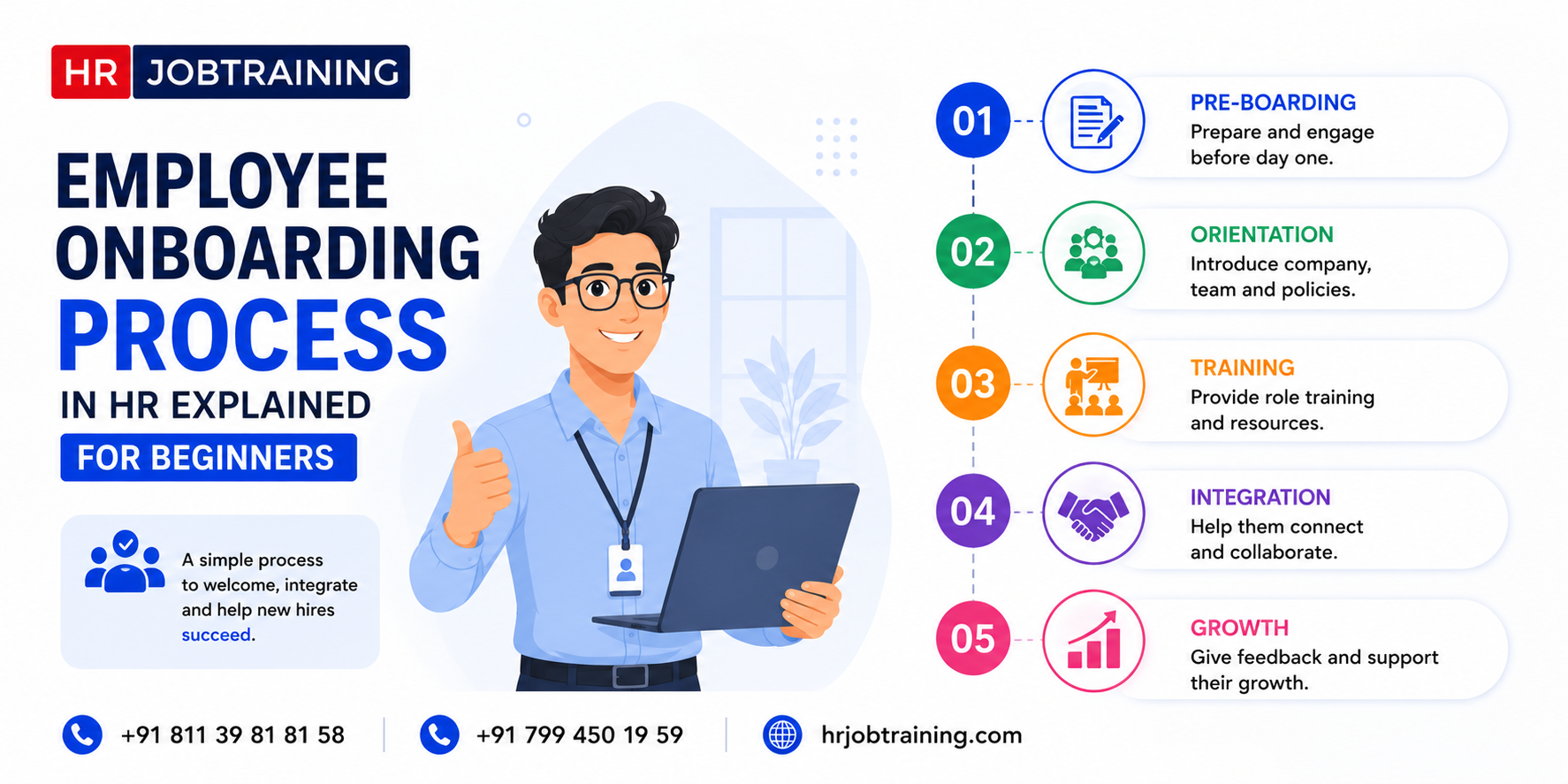
1. Preboarding Stage in Employee Onboarding
Preboarding begins immediately after the employee accepts the job offer but before the first working day.
During this stage, HR teams usually prepare offer documents, collect employee information, create system access, arrange workstation setup, and share joining instructions.
Many organizations now use welcome emails, onboarding videos, and employee handbooks to create a more professional onboarding experience.
2. Employee Orientation Process
Orientation is one of the first major onboarding activities after joining the organization.
During orientation sessions, employees learn about company policies, organizational structure, workplace culture, HR procedures, communication methods, and workplace expectations.
Organizations may also conduct office tours, employee introductions, and HR policy sessions during orientation programs.
3. Training and Role Introduction
Once orientation is completed, employees receive role-specific training and practical guidance related to their responsibilities.
Common Employee Training Areas
- Technical training
- Software systems training
- Department workflows
- Compliance training
- Company process training
- Communication systems training
Effective training helps employees gain confidence and improve workplace productivity more quickly.
4. Team Integration and Workplace Adaptation
Employee onboarding also focuses heavily on workplace integration and employee engagement.
Managers, mentors, and team members play an important role in helping employees feel comfortable and supported during the onboarding process.
Many companies now use buddy programs and mentorship systems to improve employee engagement and workplace adaptation.
Students interested in workplace HR communication can also explore: HR Communication Skills for Freshers
5. Performance Support and Feedback
Modern onboarding programs usually continue beyond the employee’s first week or first month.
HR teams and managers often conduct 30-day, 60-day, or 90-day feedback sessions to evaluate employee progress and provide additional support.
Regular feedback sessions help organizations identify workplace challenges early while improving employee development and engagement.
Modern Employee Onboarding Process in HR
Modern onboarding strategies now focus heavily on employee experience, automation, engagement, HR technology, and long-term workforce integration.
Today’s onboarding process in HR often includes digital onboarding systems, onboarding automation platforms, employee self-service portals, virtual orientation systems, and AI-powered HR workflows.
Modern Employee Onboarding Trends
- Digital onboarding platforms
- Remote onboarding programs
- AI-powered onboarding systems
- Employee self-service portals
- Virtual orientation sessions
- Automated onboarding workflows
- Personalized onboarding experiences
AI and HR automation are rapidly changing how organizations manage onboarding processes and employee workflows.
Students interested in HR technology trends can also explore: AI in HR for HR Freshers
Employee Onboarding Process Best Practices
Successful onboarding programs focus on both operational efficiency and employee experience.
Organizations that create structured onboarding systems often improve employee engagement, communication, and retention rates significantly.
Employee Onboarding Best Practices Checklist
| Best Practice | Why It Matters |
|---|---|
| Start onboarding before joining | Creates a smoother employee experience |
| Provide structured training | Improves productivity faster |
| Assign mentors or buddies | Improves employee adaptation |
| Conduct regular feedback sessions | Improves employee engagement |
| Use onboarding software | Improves efficiency and organization |
Organizations that focus on communication, mentorship, and employee support usually create stronger onboarding experiences and healthier workplace cultures.
Freshers planning practical HR careers can also explore: Practical HR Training Programs
Common Employee Onboarding Challenges
Although onboarding is extremely important for employee success, organizations often face several onboarding challenges.
Major Onboarding Challenges
- Information overload during joining
- Poor communication systems
- Insufficient employee training
- Weak workplace integration
- Lack of onboarding structure
- Manual HR documentation processes
- Poor employee engagement
Organizations increasingly use onboarding workflows and HR automation systems to improve employee onboarding efficiency and reduce onboarding-related challenges.
HR Technology in Employee Onboarding
Technology now plays a major role in modern onboarding systems.
Organizations use onboarding software to manage employee documents, training modules, communication systems, onboarding checklists, task tracking, and employee feedback.
Popular Employee Onboarding Software
- BambooHR
- Darwinbox
- Workday
- SAP SuccessFactors
- Zoho People
Students interested in enterprise HR software systems can also learn more about: SAP HR Training in Kerala
You can also explore our guide on What HR Professionals Actually Do to understand how HR teams manage onboarding, recruitment, employee engagement, and workplace operations.
How to Improve the Employee Onboarding Process
Organizations can improve onboarding experiences by focusing on communication, employee support, HR technology, mentorship, and structured onboarding workflows.
Modern onboarding systems now emphasize employee wellbeing, continuous learning, workplace support, and long-term employee development.
Simple Ways to Improve Employee Onboarding
- Create structured onboarding workflows
- Use onboarding checklists
- Improve workplace communication
- Conduct weekly employee check-ins
- Assign onboarding mentors
- Use onboarding automation tools
- Support employee wellbeing
Students planning to build HR careers can also explore:
FAQs About Employee Onboarding
What is employee onboarding?
Employee onboarding is the structured process of integrating new employees into an organization through orientation, training, communication, and workplace support activities.
Why is employee onboarding important?
Employee onboarding helps employees adapt to the workplace faster, improves engagement, increases productivity, and reduces employee turnover.
What are the stages of employee onboarding?
The main onboarding stages include preboarding, orientation, training, workplace integration, performance support, and feedback management.
What is preboarding in HR?
Preboarding is the onboarding stage that happens before the employee’s first working day and includes documentation, communication, and joining preparation activities.
How long does employee onboarding last?
Employee onboarding may last from a few weeks to several months depending on the organization, role, and onboarding strategy.
What is onboarding software?
Onboarding software helps organizations automate onboarding tasks such as document management, training coordination, employee communication, and onboarding workflows.
What is the difference between onboarding and orientation?
Orientation is usually a short introductory activity, while onboarding is a longer employee integration process focused on training, communication, support, and workplace adaptation.
Can HR freshers work in onboarding?
Yes. Many HR freshers begin their careers by assisting with recruitment coordination, onboarding activities, employee communication, and HR operations.
How does onboarding improve employee retention?
Strong onboarding experiences help employees feel supported, confident, and connected to the workplace, which improves long-term retention.
What are onboarding checklists?
Onboarding checklists help HR teams organize onboarding tasks such as documentation, training, system access, orientation, and employee communication.
Is onboarding part of Human Resource Management?
Yes. Employee onboarding is an important HR function connected to recruitment, employee engagement, training, and workforce management.
What skills are important for onboarding roles?
Communication skills, organization skills, people management abilities, training coordination, and HR software knowledge are important for onboarding-related HR roles.
Conclusion
The employee onboarding process plays a major role in helping employees adjust successfully to the workplace while improving productivity, engagement, communication, and employee retention.
Modern onboarding strategies now focus heavily on employee experience, onboarding automation, HR technology, mentorship, communication systems, and long-term workforce integration.
For beginners entering the HR field, understanding the onboarding process in HR is extremely important because onboarding directly affects workforce management and organizational performance.
At HRJobTraining.com, we regularly publish beginner-friendly HR learning resources designed to help students understand practical HR workflows, employee management systems, recruitment operations, and workplace HR responsibilities.
Build Practical HR & Employee Management Skills
If you want to gain workplace-ready HR knowledge, explore practical HR certification programs and industry-focused learning resources at HRJobTraining.com
- Explore HR Blogs and Career Resources
- Human Resource Management Guide
- HR Career Opportunities in Pattambi
- Practical HR Training Programs
- IIA International HR Blogs