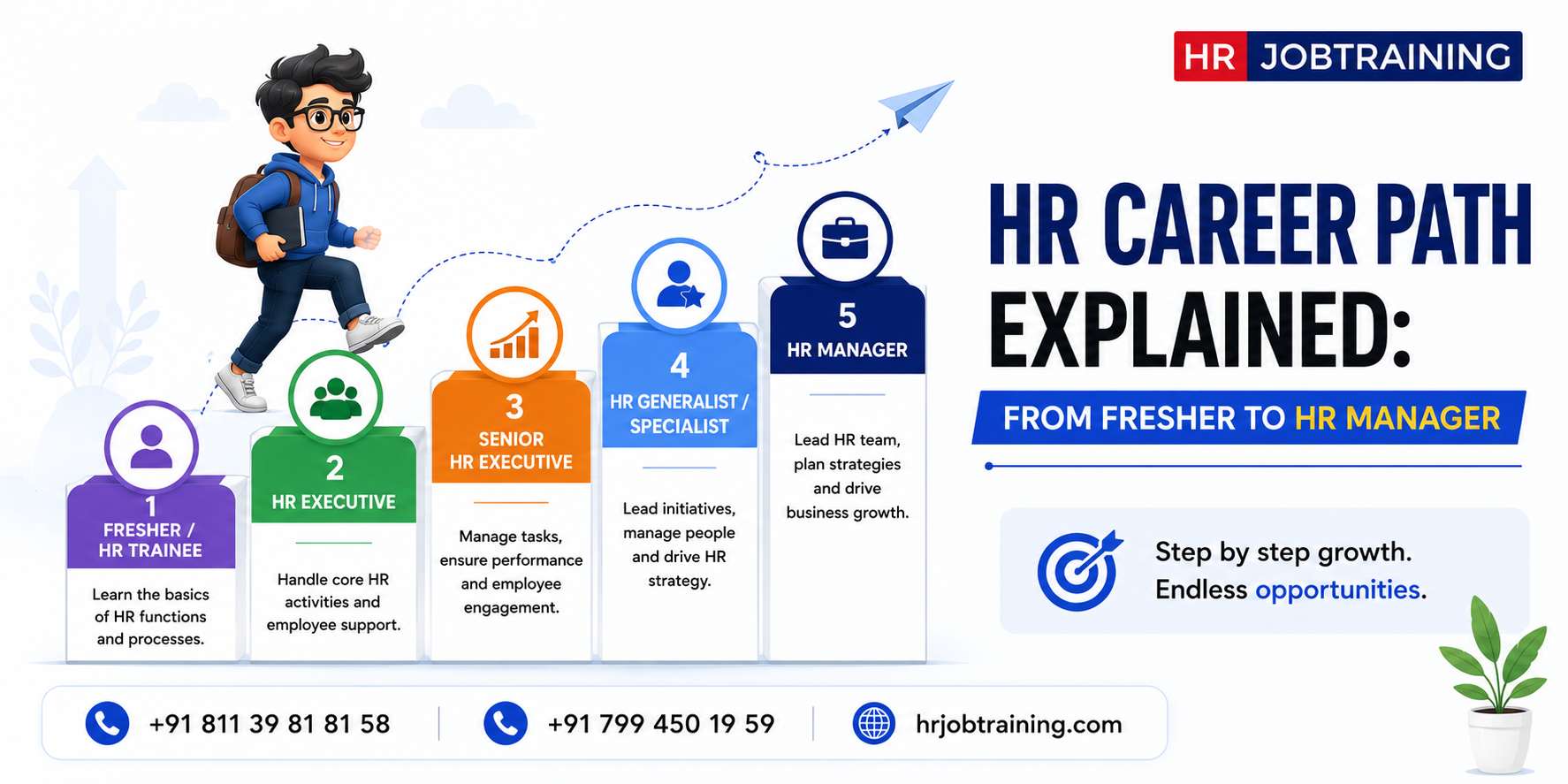
The HR industry has evolved significantly over the last few years. Modern organizations now expect HR professionals to manage recruitment, employee engagement, onboarding, payroll coordination, HR technology systems, communication, workforce planning, and organizational culture.
Because of this, the HR career path now offers excellent long-term growth opportunities for students and working professionals interested in Human Resource Management.
Whether you are a fresher exploring HR jobs or someone planning to transition into Human Resources, understanding the complete HR career progression can help you make better career decisions and develop the right workplace skills.
At HRJobTraining.com, we regularly help HR learners understand recruitment systems, onboarding workflows, employee management, payroll operations, HR software systems, and practical workplace HR responsibilities.
Quick Summary:
The HR career path usually begins with HR assistant or HR coordinator roles and gradually progresses into HR executive, HR generalist, HR specialist, HR manager, and senior HR leadership positions depending on skills, experience, and HR specialization.
In this beginner-friendly guide, you will learn:
- HR career path step by step
- HR growth opportunities
- Entry-level HR jobs for freshers
- Skills needed for HR career growth
- HR salary progression
- How to become an HR manager
- Best HR courses for career growth
If you are new to HR, you can also explore our detailed Human Resource Management guide to understand the core responsibilities and functions of HR professionals.
Table of Contents
- What Is the HR Career Path?
- Why HR Careers Are Growing
- Entry-Level HR Jobs for Freshers
- HR Career Path Step by Step
- Skills Needed for HR Career Growth
- HR Salary Growth Opportunities
- Best HR Courses for Career Development
- How to Become an HR Manager
- Future HR Growth Opportunities
- FAQs About HR Careers
What Is the HR Career Path?
The HR career path refers to the professional growth journey followed by Human Resource professionals as they gain experience, skills, certifications, and workplace exposure.
Most HR careers begin with junior HR coordination roles and gradually move toward specialized or managerial positions.
Modern HR departments now include multiple specializations such as recruitment, payroll, HR operations, employee engagement, onboarding, training and development, HR analytics, and HR technology systems.
Because of this, HR professionals now have multiple HR growth opportunities depending on their interests and workplace experience.
Why HR Careers Are Growing
HR careers are growing rapidly because organizations increasingly understand the importance of employee engagement, workplace culture, HR technology, workforce planning, and talent management.
Today’s companies depend heavily on HR teams to manage recruitment workflows, onboarding systems, communication strategies, performance management, and employee wellbeing.
Major Reasons HR Careers Are Growing:
- Increased hiring across industries
- Growing focus on employee experience
- Expansion of HR technology systems
- Demand for HR software knowledge
- Growth in UAE and Gulf HR opportunities
- Rise of AI and digital HR operations
Students interested in Gulf HR opportunities can also explore: HR Career in UAE
You can also read: HR Jobs in Kerala 2026 to understand how HR demand is increasing across industries.
Entry-Level HR Jobs for Freshers
Most HR professionals begin their careers through entry-level HR roles where they learn practical HR workflows and workplace operations.
Common HR Jobs for Freshers
| HR Job Role | Main Responsibilities |
|---|---|
| HR Assistant | Documentation, coordination, employee support |
| HR Coordinator | Recruitment scheduling and onboarding support |
| HR Executive | Recruitment, employee engagement, HR operations |
| Payroll Assistant | Attendance and payroll coordination |
| Recruitment Executive | Candidate sourcing and interview coordination |
Freshers often begin by learning recruitment processes, onboarding systems, employee communication, payroll workflows, and HR software platforms.
Students can also explore: What Does an HR Professional Do? to understand daily HR responsibilities in real workplaces.
HR Career Path Step by Step
The HR career path usually develops gradually as professionals gain experience, workplace exposure, certifications, and practical HR skills.
Typical HR Career Progression
- HR Intern
- HR Assistant
- HR Coordinator
- HR Executive
- HR Generalist
- HR Specialist
- HR Manager
- Senior HR Manager
- HR Business Partner
- HR Director
HR Intern or Trainee
Many HR careers begin with internships or trainee positions where freshers learn recruitment coordination, onboarding support, employee communication, and HR documentation processes.
HR Executive or HR Coordinator
After gaining initial workplace exposure, professionals usually move into HR executive or HR coordinator roles where they handle recruitment workflows, onboarding processes, payroll coordination, and employee engagement activities.
Students interested in recruitment systems can also read: HR Recruitment Process Step by Step
HR Generalist or HR Specialist
At this stage, HR professionals often begin specializing in areas such as recruitment, payroll, training and development, employee engagement, HR operations, or HR technology.
Modern organizations increasingly prefer HR professionals with practical HR software exposure and communication skills.
HR Manager
HR managers usually handle recruitment planning, employee management, HR operations, workforce coordination, HR policy implementation, and organizational HR strategy.
Strong leadership skills, communication abilities, and HR operational knowledge are essential for HR manager roles.
Skills Needed for HR Career Growth
Modern HR careers require both technical HR knowledge and strong interpersonal workplace skills.
Most Important HR Skills
| HR Skill | Why It Matters |
|---|---|
| Communication Skills | Improves employee coordination and workplace communication |
| Recruitment Skills | Supports hiring and talent acquisition |
| HR Software Skills | Supports digital HR operations |
| Leadership Skills | Improves workplace management |
| Employee Management | Supports engagement and retention |
Students can also read: Top HR Skills Required for HR Jobs for a complete HR skills guide.
You can also explore: HR Skills for Freshers to understand workplace-ready HR skills required in modern companies.
HR Salary Growth Opportunities
The HR field offers good salary growth opportunities depending on experience, specialization, location, and technical HR skills.
Average HR Salary Progression
- HR Intern → Entry-level stipend or trainee salary
- HR Executive → Moderate beginner salary package
- HR Generalist → Higher operational salary growth
- HR Manager → Strong managerial salary package
- Senior HR Roles → Leadership-level compensation
Professionals with HR software knowledge, payroll expertise, recruitment experience, SAP HR skills, and communication abilities often receive better salary opportunities.
Best HR Courses for Career Development
Practical HR training plays a major role in helping students build workplace-ready HR skills.
Many students searching for the best HR course in Kerala now prefer programs that include recruitment training, onboarding systems, payroll management, HR software learning, SAP HR exposure, and workplace HR workflows.
At IIA International, many students consider the institute among the no.1 HR institute in Kerala options because of its practical HR learning approach, HR software training, SAP HR programs, recruitment exposure, and career-oriented HR courses.
Students searching for an HR course in Kerala can also explore:
- Best HR Course in Pattambi
- HR Training Courses in Palakkad
- Thrissur HR Courses
- Human Resource Courses in Thrissur
- Kottakkal HR Courses
- HR Courses in Malappuram
- Kozhikode HR Courses
- Human Resource Courses in Kozhikode
How to Become an HR Manager
Becoming an HR manager usually requires a combination of practical HR experience, communication skills, HR operational knowledge, leadership abilities, and workplace coordination experience.
Steps to Become an HR Manager
- Learn HR fundamentals
- Complete practical HR training
- Gain recruitment and onboarding experience
- Learn HR software systems
- Improve communication and leadership skills
- Gain workplace HR exposure
- Develop employee management abilities
Students can also read: Core Functions of Human Resource Management to understand the practical responsibilities handled by HR managers.
Future HR Growth Opportunities
The future of HR careers looks very promising because organizations increasingly depend on HR professionals for workforce planning, employee engagement, recruitment, HR analytics, onboarding systems, and digital HR operations.
Modern HR careers are also evolving because of AI-powered HR systems, automation tools, and HR technology platforms.
Students interested in AI-driven HR careers can also explore: AI in HR for HR Freshers
You can also explore: Future of HR Careers in Kerala to understand upcoming HR growth opportunities.
FAQs About HR Career Path
What is the HR career path?
The HR career path refers to the professional progression from beginner HR roles to managerial and leadership positions in Human Resource Management.
What are the best HR jobs for freshers?
Common HR jobs for freshers include HR assistant, HR coordinator, recruitment executive, payroll assistant, and HR executive roles.
How can I become an HR manager?
You can become an HR manager by gaining HR experience, improving communication skills, learning HR software systems, and developing leadership abilities.
What skills are needed for HR careers?
Communication, recruitment, leadership, employee management, HR software knowledge, and workplace coordination skills are important for HR careers.
Is HR a good career option in 2026?
Yes. HR is considered a strong career option because organizations increasingly focus on recruitment, employee engagement, workforce planning, and HR technology systems.
Which HR course is best in Kerala?
Students often prefer practical HR training programs that include recruitment systems, HR software learning, onboarding workflows, payroll systems, and SAP HR exposure.
Can HR professionals work in UAE companies?
Yes. HR professionals with communication skills, HR software knowledge, recruitment experience, and practical HR exposure often find opportunities in UAE companies.
What is the salary growth in HR careers?
HR salary growth depends on experience, specialization, technical HR skills, HR software exposure, and workplace leadership responsibilities.
What are HR growth opportunities?
HR growth opportunities include recruitment specialization, payroll management, HR operations, employee engagement, HR analytics, and HR leadership roles.
Can commerce students choose HR careers?
Yes. Many commerce, management, and arts students successfully build careers in Human Resource Management through practical HR training and workplace exposure.
Conclusion
The HR industry now offers excellent career growth opportunities for students and professionals interested in recruitment, employee management, onboarding, payroll systems, workplace communication, and HR technology.
The HR career path usually begins with entry-level HR coordination roles and gradually progresses into specialized and managerial HR positions.
For beginners entering Human Resource Management, learning practical HR skills, communication abilities, HR software systems, recruitment workflows, and workplace operations is extremely important for long-term HR career growth.
At HRJobTraining.com, we regularly publish beginner-friendly HR learning resources to help students understand recruitment, onboarding, employee management, HR operations, and modern HR career opportunities.
Build Your HR Career with Practical HR Training
If you want to develop workplace-ready HR skills and build a successful HR career, explore practical HR learning resources and industry-focused HR training opportunities at: HRJobTraining.com