Many students and beginners entering the business and Human Resources field often get confused between the terms HR and HRM. Although these two terms are closely connected, they are not exactly the same.
Understanding the difference between HR and HRM is important for students, freshers, and professionals who want to build a successful career in Human Resources.
Today, companies across India, Kerala, UAE, and global markets rely heavily on structured workforce management systems. Because of this, Human Resource Management has become one of the fastest-growing professional career fields.
In this beginner-friendly guide, you will clearly understand:
- What HR means
- What HRM means
- HR vs HRM differences
- Main HRM functions
- Why HRM is important
- HR career opportunities
- Skills required for HR careers
- How to start a career in HR
If you are completely new to this field, you can also read our detailed guide on What Is Human Resource Management?
Table of Contents
- What Is HR?
- What Is HRM?
- Difference Between HR and HRM
- Main Functions of HRM
- Why HRM Is Important
- HR Career Opportunities
- Skills Required for HR Careers
- HR Software and Technology
- How to Start an HR Career
- FAQs About HR and HRM
What Is HR?
HR stands for Human Resources.
It refers to the department within an organization that manages employee-related activities and workplace operations.
The HR department usually handles:
- Recruitment
- Employee onboarding
- Attendance tracking
- Payroll coordination
- Leave management
- Employee communication
- Workplace policies
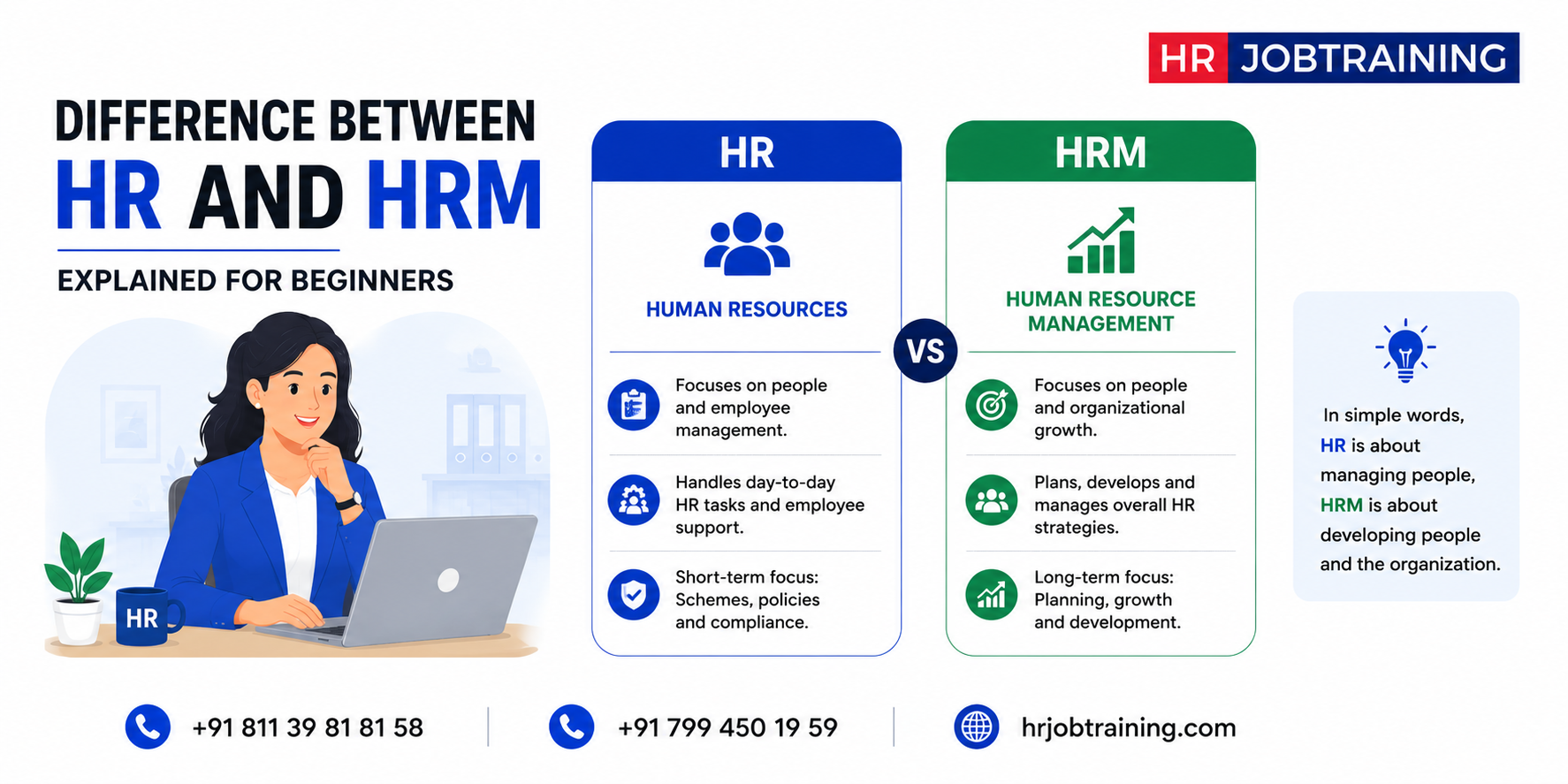
In simple words, HR focuses on managing employees and supporting daily workplace operations.
Earlier, HR departments mainly handled administrative tasks like attendance tracking and salary processing. However, modern HR teams now contribute directly to organizational growth and employee development.
Today’s HR professionals also support:
- Employee engagement
- Performance management
- Recruitment strategy
- Training and development
- Workplace culture
- Workforce planning
To understand modern HR roles better, explore our guide on What Does an HR Professional Do?
What Is HRM?
HRM stands for Human Resource Management.
Human Resource Management is the complete process of managing employees strategically to improve both business performance and employee growth.
Unlike basic HR operations, HRM focuses on long-term workforce planning and organizational development.
HRM includes:
- Recruitment strategy
- Employee training
- Performance management
- Employee engagement
- Leadership development
- Workforce planning
- HR compliance
- Organizational culture management
Simple Explanation:
* HR refers to the department.
* HRM refers to the complete management strategy behind employee management.
Modern organizations now consider HRM one of the most important parts of business success because employees directly affect productivity and company growth.
Difference Between HR and HRM
Although HR and HRM are connected, there are several important differences between them.
| HR | HRM |
|---|---|
| Focuses on employee administration | Focuses on strategic workforce management |
| Mainly operational | Long-term and strategic |
| Handles recruitment and payroll tasks | Improves employee productivity and development |
| Supports workplace operations | Aligns employee goals with business goals |
| Department-based approach | Management and planning approach |
In modern organizations, HR and HRM work together to improve employee satisfaction, workplace culture, and business performance.
Main Functions of HRM
Human Resource Management includes several important functions that support both employees and organizations.
1. Recruitment and Hiring
Recruitment is one of the most important HRM functions.
HR teams manage:
- Job postings
- Candidate screening
- Interviews
- Hiring coordination
- Employee onboarding
Strong recruitment systems help organizations hire skilled employees and reduce employee turnover.
2. Employee Training and Development
Modern HRM focuses heavily on employee skill development.
Organizations regularly conduct:
- HR training programs
- Leadership workshops
- Employee coaching
- Skill development sessions
Many students now prefer practical HR training programs to gain real workplace exposure before applying for jobs.
3. Payroll and Compensation Management
HR professionals also manage payroll and employee benefits.
This includes:
- Salary processing
- Attendance systems
- Leave management
- Employee benefits
- Payroll compliance
Payroll accuracy directly affects employee trust and workplace satisfaction.
4. Employee Engagement
Employee engagement is now a major part of modern HRM systems.
HR departments organize:
- Team-building activities
- Recognition programs
- Wellness initiatives
- Employee communication systems
You can also explore these employee engagement strategies used by successful HR teams.
5. Performance Management
Performance management helps organizations improve productivity.
HR professionals conduct:
- Employee appraisals
- Goal tracking
- Performance reviews
- Feedback sessions
This helps companies identify high-performing employees and improve workforce efficiency.
6. HR Compliance
HR departments ensure organizations follow:
- Labor laws
- Employee rights policies
- Workplace safety regulations
- Payroll compliance rules
Compliance management helps organizations avoid legal and workplace issues.
Why HRM Is Important in Modern Organizations
Human Resource Management has become extremely important because employees are considered one of the most valuable assets of any organization.
Modern businesses use HRM systems to:
- Improve employee productivity
- Build strong workplace culture
- Increase employee engagement
- Reduce employee turnover
- Improve communication
- Support organizational growth
Companies with effective HRM systems usually experience better employee satisfaction and stronger business performance.
HR Career Opportunities
Human Resource Management offers multiple career opportunities across different industries.
Popular HR job roles include:
- HR Executive
- Talent Acquisition Specialist
- HR Generalist
- Payroll Specialist
- HR Manager
- Employee Relations Executive
- HR Business Partner
- HR Administrator
Today, HR professionals are in demand across:
- IT companies
- Healthcare organizations
- Retail businesses
- Manufacturing industries
- Educational institutions
- GCC companies
Students interested in HR careers can also explore:
Skills Required for HR Careers
To build a successful HR career, professionals need both technical and interpersonal skills.
Communication Skills
HR professionals communicate with employees, managers, and job candidates daily.
Strong communication skills help HR professionals:
- Conduct interviews confidently
- Resolve workplace issues
- Improve employee relationships
- Support workplace culture
Leadership and Problem-Solving
HR departments regularly handle employee concerns and workplace conflicts.
Strong leadership skills help HR professionals manage these situations effectively.
Organizational Skills
HR teams manage multiple responsibilities at the same time.
Good time management and organizational skills are extremely important in HR careers.
HR Software Knowledge
Modern organizations use HR software systems for:
- Recruitment management
- Payroll processing
- Attendance tracking
- HR analytics
- Performance management
Students interested in HR technology can explore this SAP HR Course to understand enterprise HR systems.
HR Software and Technology
Technology now plays a major role in Human Resource Management.
Popular HR software systems include:
- SAP HR
- Oracle HCM
- BambooHR
- Zoho People
- Workday
Modern HR professionals increasingly use software systems to automate workforce management processes.
Learning HR technology can improve:
- Job opportunities
- Salary potential
- Workplace efficiency
- Recruitment management skills
How to Start an HR Career
If you want to build a career in HR, following a structured learning path can help improve employability.
Step 1: Learn HR Fundamentals
- Recruitment
- Payroll
- Employee management
- HR compliance
- Workplace communication
Step 2: Get Practical HR Training
Practical HR exposure helps students understand real workplace HR processes.
Many students now explore best HR courses for career growth to gain industry-ready skills.
HRJobTraining provides practical HR training programs focused on:
- Recruitment process training
- Payroll management
- HR documentation
- Employee engagement practices
- HR software exposure
- GCC HR administration
- Workplace communication skills
Step 3: Learn HR Software Systems
Modern companies increasingly use HR software systems to automate workforce management processes.
- Job opportunities
- Salary potential
- Recruitment management skills
- Payroll management capabilities
Step 4: Stay Updated With HR Trends
Follow HR blogs, labor law updates, recruitment trends, and workforce management developments regularly.
Continuous learning helps HR professionals stay competitive in the job market.
FAQs About HR and HRM
What is the difference between HR and HRM?
HR refers to the Human Resources department, while HRM refers to the strategic management process used to manage employees and workforce development.
Is HRM better than HR?
HRM is not separate from HR. HRM is the broader strategic approach that includes recruitment, training, employee engagement, and workforce planning.
Is HR a good career option?
Yes. HR is one of the fastest-growing career fields with opportunities across IT, healthcare, retail, education, and GCC sectors.
Can freshers start a career in HR?
Yes. Many organizations hire freshers for HR assistant and HR executive roles.
What qualifications are needed for HR jobs?
Most HR professionals complete BBA, MBA in HR, diploma programs, or practical HR certification courses before entering the industry.
What does an HR executive do?
An HR executive usually handles recruitment support, employee onboarding, attendance tracking, payroll coordination, and workplace communication.
Is Human Resource Management difficult to learn?
No. HRM can be learned step by step through practical training, industry exposure, and understanding workplace management processes.
Which HR course is best for beginners?
Beginners usually benefit from practical HR training programs that include recruitment, payroll, HR administration, and HR software training.
What are the main functions of Human Resource Management?
The main HRM functions include recruitment, training and development, payroll management, employee engagement, performance management, and HR compliance.
Does HRM include payroll management?
Yes. Payroll processing and compensation management are important parts of Human Resource Management systems.
Can HR professionals work abroad?
Yes. Skilled HR professionals are in demand across GCC countries, multinational companies, healthcare organizations, retail businesses, and IT companies.
Why is HR important in companies?
HR helps organizations manage employees effectively, improve workplace culture, support recruitment processes, and increase overall productivity.
Conclusion
Understanding the difference between HR and HRM helps beginners understand how modern organizations manage employees, workplace culture, and workforce development.
While HR mainly focuses on employee-related operations like recruitment and payroll coordination, HRM focuses on long-term workforce planning and employee development.
Today’s HR professionals play a major role in recruitment, employee engagement, training and development, payroll coordination, HR compliance, and organizational growth.
As businesses continue focusing on workforce management, HR career opportunities are expected to grow rapidly across India, Kerala, UAE, and global markets.
Start Your HR Career with Practical Industry Training
If you want to build workplace-ready HR skills, explore practical HR courses and certification programs at HRJobTraining.com
Popular learning resources:
- What Is Human Resource Management?
- HR Career Opportunities in Kerala
- Future of HR Careers in Kerala
- Practical HR Training Programs
Related Articles
- What Is Human Resource Management?
- What Does an HR Professional Do?
- Employee Engagement Strategies
- Future of HR Careers in Kerala
- Practical HR Training Programs
- HR Jobs in Kerala 2026
- HR Skills for Freshers 2026
- Best HR Course for UAE Jobs in Kerala
- SAP HR Course Kerala 2026
- AI in HR for HR Freshers 2026
- HR Communication Skills 2026