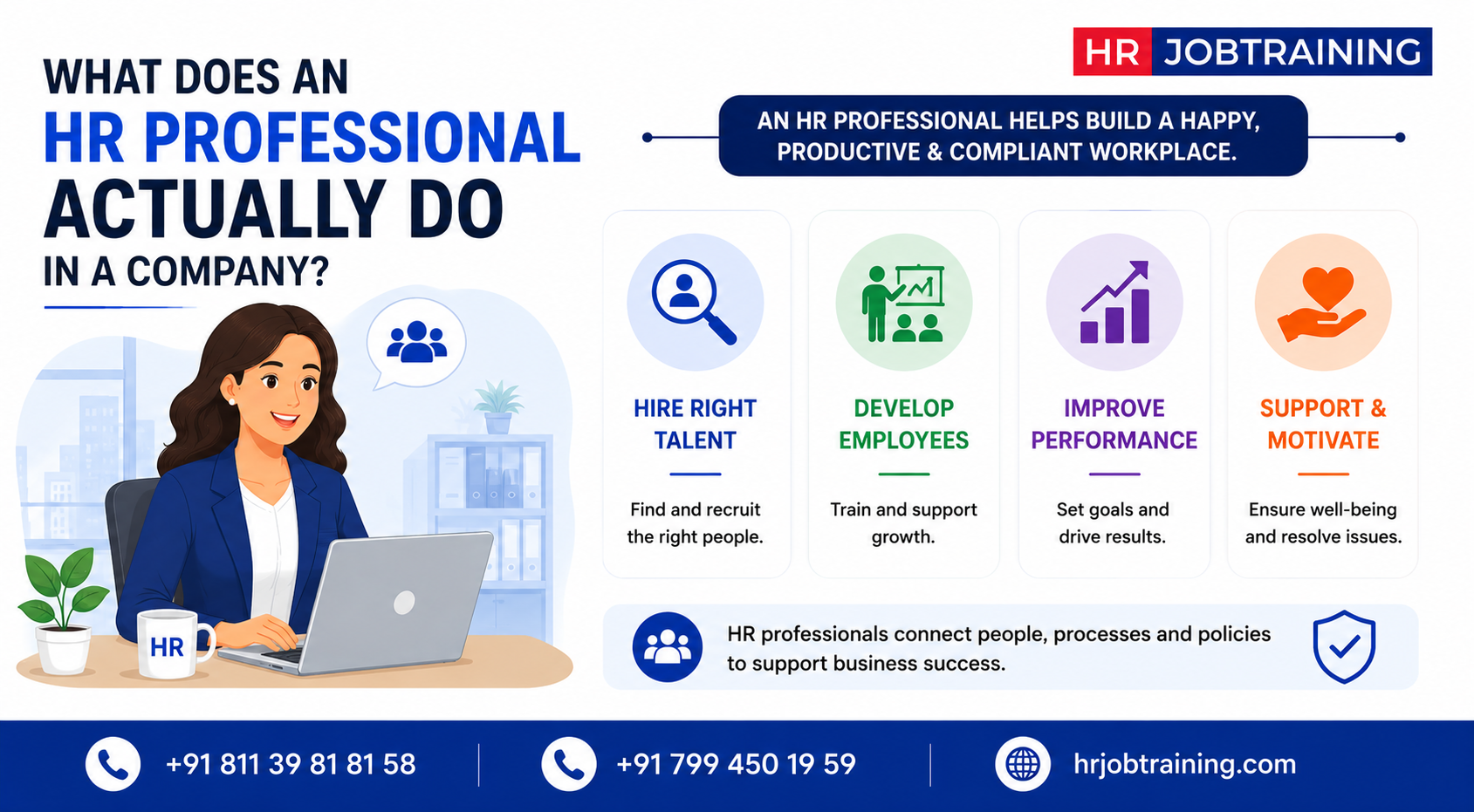
Most people know HR exists. But very few — including fresh graduates — truly understand what an HR professional does every single day inside a company.
Is it just hiring? Only paperwork? Or is it something far more powerful than that?
The truth is, HR professionals are the backbone of every successful organisation. They manage talent, culture, compliance, performance, and people strategy — all at once. According to the U.S. Bureau of Labor Statistics, employment for HR specialists is projected to grow 8% from 2023 to 2033, faster than the average for all occupations — and demand is equally strong in Kerala’s growing job market.
If you’re a student or fresher in Palakkad, Pattambi, or anywhere in Kerala wondering whether HR is the right career, this article breaks down every real responsibility an HR professional handles — and why structured HR training courses in Palakkad can give you a genuine career edge in 2026.
Key Takeaways
- HR professionals are projected to see 8% employment growth through 2033 (U.S. Bureau of Labor Statistics, 2025).
- Formal onboarding — a core HR function — results in 50% higher employee retention (PerformYard, 2025).
- In 2026, 33% of HR teams already use AI technology, making tech skills essential for HR professionals (PerformYard, 2025).
- HR is no longer administrative — it covers recruitment, compliance, training, culture, and workforce planning.
What Is an HR Professional, Really?
An HR professional — short for Human Resources professional — is the person responsible for managing the most important asset any company has: its people. As of 2026, Robert Half’s HR hiring trends report found that HR roles now span analytics, compliance, workforce planning, employee engagement, and HR technology — making it one of the most multi-dimensional careers available to graduates.
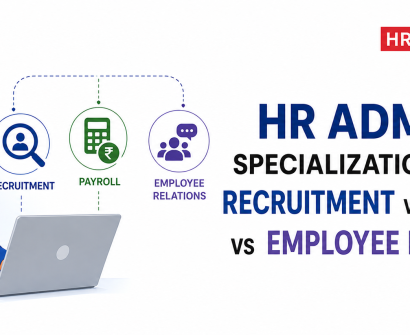
HR isn’t a single job. It’s a broad function with many specialisations. In small companies, one HR person might handle everything. In larger organisations, entire teams manage different HR verticals. Here’s how the HR function typically breaks down:
- HR Generalist — handles all aspects of HR for a company or department
- HR Recruiter / Talent Acquisition Specialist — focuses on hiring
- HR Business Partner — aligns HR strategy with business goals
- Payroll and Compliance Specialist — manages salaries and legal obligations
- Learning and Development (L&D) Specialist — manages training and upskilling
- Employee Relations Specialist — handles workplace conflicts and culture
Understanding this variety is the first step to knowing which HR career path suits you — and which skills to build through quality HR courses for career growth.
Our finding: Most HR freshers in Kerala focus only on recruitment, missing the bigger picture. Companies increasingly seek HR professionals who understand compliance, payroll software, and workforce planning from day one — not just interviewing skills.
What Are the Core Responsibilities of an HR Professional?

In 2025–2026, according to Robert Half’s HR hiring analysis, the strongest demand in HR roles is centred on compensation, learning and development, and strategic hiring support. Here’s a deep look at what HR professionals actually do every working day.
1. Recruitment and Talent Acquisition
This is the most visible HR function. HR professionals write job descriptions, post openings, screen resumes, coordinate interviews, and manage the offer process. Good recruiters don’t just fill positions — they find people who fit the company’s culture and long-term vision.
In 2025, over 16,500 of the 30,300 HR job postings tracked by Robert Half were for HR and L&D roles, showing that talent acquisition and employee development remain the heart of the function.
2. Onboarding and Employee Integration
Hiring doesn’t end when someone signs the offer letter. HR professionals design and run onboarding programmes that help new employees settle in, understand their role, and connect with company culture.
Formal onboarding programmes result in 50% higher employee retention and a 62% productivity increase (PerformYard, 2025). This is why skilled HR professionals treat onboarding as a strategic investment, not just a formality.
3. Payroll Management and Compensation
HR professionals ensure every employee is paid correctly and on time. They also manage benefits including provident fund (PF), employee state insurance (ESI), gratuity, and leave entitlements. In India, payroll compliance is governed by multiple laws — the Payment of Wages Act, the Factories Act, and the Employees’ Provident Funds Act. Getting this wrong has serious legal consequences.
Learn practical HR payroll skills through practical HR training in Palakkad designed for working professionals and freshers alike.
4. Labour Law Compliance and Legal Responsibilities
Every company must follow labour laws. HR professionals are responsible for ensuring the organisation stays compliant with:
- Industrial Disputes Act
- Shops and Establishments Act
- Maternity Benefit Act
- Prevention of Sexual Harassment (POSH) Act
- Contract Labour Act
A single compliance failure can expose a company to fines, legal action, and reputational damage. This is why HR professionals with strong knowledge of Indian labour law are consistently in demand across Kerala.
Our finding: Compliance knowledge is the most undervalued skill among HR freshers. Yet in interviews, employers consistently test candidates on basic labour law — particularly PF, ESI, and the Contract Labour Act. Structured training makes a real difference here.
How Does an HR Professional Support Employee Performance?
Impact of HR Performance Management Practices Source: PerformYard & Paycor HR Research, 2025 Retention +50% Productivity +62% Engagement +83% AI Adoption 33% Key HR performance impact statistics — PerformYard & Paycor HR Research, 2025
Performance management is one of the most strategic functions an HR professional handles. Companies that adopt recognition practices see an 83% increase in employee engagement (PerformYard, 2025) — and engagement is directly tied to productivity, retention, and business growth.
HR professionals design and manage performance review systems, goal-setting frameworks, feedback mechanisms, promotion cycles, and structured improvement plans. Without this, performance reviews become inconsistent, promotions feel unfair, and employees disengage.
According to Gartner’s 2026 CHRO Priorities research, HR leaders are now developing “now-next” talent strategies to balance immediate performance with long-term goals — meaning HR professionals need both operational and strategic skills.
Understand the full scope of HR performance management through the future of HR careers in Kerala guide.
What Role Does HR Play in Training and Development?

Training and development is a fast-growing area of HR. According to SHRM’s 2025 Talent Trends report, more than half of organisations (54%) require new or updated skills driven by company growth — and 53% are updating roles because of changing technology.
HR professionals in this area identify skill gaps, design or source training programmes, coordinate with external training providers, track training effectiveness, and manage learning management systems (LMS).
This is especially relevant in Kerala, where companies in manufacturing, healthcare, IT, and services are rapidly upskilling their workforce. AIHR’s 2026 HR Trends report noted that even though 98% of organisations are accelerating AI integration, very few feel truly ready to scale it — making HR professionals who can bridge the human-technology gap highly sought after.
Explore how to build L&D skills through HR career opportunities in Pattambi and surrounding areas.
How Do HR Professionals Handle Employee Relations and Workplace Culture?
According to Paycor’s HR in 2025 survey, 63% of workers who feel they have balanced work and personal lives are willing to go “above and beyond” for their company. Building that balance isn’t accidental — it’s a deliberate outcome of strong HR work in employee relations and culture.
Handling Workplace Conflicts
When two employees disagree, or when a manager is perceived as unfair, HR steps in. HR professionals investigate complaints, mediate disputes, and document resolutions. They must be impartial, empathetic, and legally informed.
Implementing POSH (Prevention of Sexual Harassment)
Under the Sexual Harassment of Women at Workplace Act, 2013, every company with more than 10 employees must have an Internal Complaints Committee (ICC). HR professionals typically chair or coordinate this committee, conduct awareness training, and handle complaints through the proper legal process.
Building Company Culture
Culture isn’t a poster on the wall. HR professionals design employee engagement programmes, recognition systems, team-building initiatives, and feedback cultures that make employees feel valued.
Managing Employee Exits
When employees resign or are terminated, HR handles exit interviews, full-and-final settlements, relieving letters, and experience certificates — all within legal timelines and compliance requirements.
From the training floor: Students who join IIA HR Academy’s practical training consistently tell us that employee relations was the area they least expected to love — and the one they found most impactful once they started working.
What Does HR Do With Data and Technology in 2026?
HR Technology Adoption in 2026 Source: AIHR HR Trends Report 2026 | PerformYard 2025 98% Accelerating AI 98% orgs accelerating AI (AIHR, 2026) 78% deploying AI in ≥1 HR function 41% building HR service apps 33% already use AI tools in HR Sources: AIHR 2026 HR Trends | PerformYard 2025 HR Statistics HR technology adoption trends — AIHR 2026 HR Trends Report & PerformYard 2025
AIHR’s 2026 HR Trends report found that 98% of organisations are accelerating AI integration — and HR professionals are right at the centre of managing this transition. HR is no longer just a people function; it’s increasingly a data and technology function.
Modern HR professionals use HRMS platforms like SAP HCM, Zoho People, or Keka to manage employee data and payroll; applicant tracking systems (ATS) to filter job applications at scale; performance management software for appraisals; and analytics dashboards to track attrition rates, hiring costs, and workforce trends.
According to PerformYard (2025), 33% of HR teams already use AI technology, and 41% are building apps to distribute HR services. HR professionals who understand SAP HCM or other HRMS platforms are especially in demand — which is one reason SAP HCM training is a core module in advanced HR programmes at IIA International.
Gartner’s 2026 CHRO Priorities report confirmed that evolving the HR operating model has the highest predicted impact on AI productivity gains at 29% — putting HR professionals who understand technology at the forefront of business transformation. Learn SAP HCM and HRMS skills through HR training in Palakkad.
Why Is HR Strategic — Not Just Administrative?
One of the most common misconceptions about HR is that it’s purely an administrative function. It isn’t. According to the Deloitte 2026 Global Human Capital Trends report, the top priority for CHROs is developing “now-next” talent strategies that balance immediate workforce needs with long-term business transformation.
Strategic HR professionals work on workforce planning (forecasting how many people the business needs in 1–3 years), succession planning (identifying future leaders), employer branding, diversity and inclusion (DEI), and organisational design.
This shift from administrative to strategic is why companies now expect HR professionals to understand business, not just people. HR graduates who combine practical skills with strategic thinking are getting hired faster — which is what structured HR diploma programmes are designed to deliver.
Is HR a Good Career Choice in Palakkad and Kerala in 2026?
HR Job Market 2025–2026 Source: Robert Half HR Hiring Trends Report, 2026 HR Employment Growth 8% (2023–33) HR postings 2025 30,300+ HR leaders finding skilled talent harder 59% Compensation HR unemployment rate Only 0.8% Source: Robert Half HR Hiring Trends, February 2026 | U.S. Bureau of Labor Statistics, 2025 HR job market indicators — Robert Half HR Hiring Report, 2026
According to Robert Half’s 2026 HR hiring trends analysis, nearly 6 in 10 HR leaders (59%) say it’s more difficult to find skilled HR talent than it was a year ago. This is good news for freshers willing to invest in real, practical training.
In Kerala, the HR job market is growing alongside the expanding IT, healthcare, construction, and manufacturing sectors. Companies in Palakkad, Thrissur, Ernakulam, and Kozhikode are actively hiring HR coordinators, executives, and generalists.
The key differentiator is practical skills. Employers want HR candidates who can handle payroll software, understand labour law, operate HRMS platforms, and conduct professional interviews. This is exactly the gap that practical HR training in Palakkad is designed to fill.
If you’re a B.Com, BBA, or MBA graduate in Pattambi or anywhere in the Palakkad district, also read: best career options after B.Com in Pattambi.
Ready to start your HR career in Palakkad? IIA HR Academy offers structured HR diploma programmes covering recruitment, payroll, labour law, HRMS, and performance management — taught by working HR professionals.Explore HR Training Courses in Palakkad →
Frequently Asked Questions
What does an HR professional do on a daily basis?
On a typical day, an HR professional screens job applications, coordinates interviews, processes payroll inputs, handles employee queries about benefits or attendance, and follows up on compliance documentation. According to Robert Half (2026), HR roles now span analytics, compliance, engagement, and workforce planning — making it a genuinely varied and dynamic career.
Is HR a good career for freshers in Palakkad and Kerala?
Yes — the demand for skilled HR freshers in Kerala is strong and growing. The U.S. Bureau of Labor Statistics (2025) projects HR specialist employment to grow 8% through 2033. In Kerala, manufacturing, healthcare, and IT sectors are all actively hiring HR executives. The key is gaining practical skills in payroll, labour law, and HRMS through structured training before entering the job market.
What qualifications do I need to become an HR professional in India?
Most HR entry-level roles require a Bachelor’s degree — B.Com, BBA, or any graduate degree. An MBA in HR is valued for senior roles. Practical HR training programmes covering payroll software, labour law, recruitment processes, and HRMS tools often give candidates a stronger advantage than a degree alone, especially for immediate placement.
What is the salary of an HR professional in Kerala?
Entry-level HR executives in Kerala typically earn ₹15,000–₹25,000 per month depending on company and location. With 2–4 years of experience and skills in payroll or HRMS platforms like SAP HCM, salaries can rise to ₹35,000–₹60,000+ monthly. According to Indeed (2025), HR managers in India with specialised skills earn significantly more.
How is HR changing in 2026?
HR is evolving rapidly. Gartner’s 2026 CHRO Priorities report lists AI transformation, workforce redesign, and culture-driven performance as top priorities for HR leaders globally. HR professionals who combine people skills with data literacy, HRMS knowledge, and strategic thinking are the most in-demand profiles — creating new opportunities for well-trained HR freshers across Kerala.
Conclusion
An HR professional isn’t just an admin person who files paperwork. They recruit the right talent, ensure payroll runs on time, keep the company legally compliant, manage performance, build culture, and prepare the organisation for the future.
HR in 2026 is strategic, technology-driven, and people-centric all at once — and that’s exactly what makes it such a rewarding career.
If you’re in Palakkad, Pattambi, or anywhere in Kerala, the opportunity is real. The growing demand for skilled HR professionals isn’t slowing down. Start with the right training, build the right skills, and walk into your first HR role ready to deliver from day one.
View HR Training Courses in Palakkad →
Stay updated with the latest HR career insights on the IIA HR Academy blog. For the full range of HR and accounting programmes available across Kerala, visit IIA International.